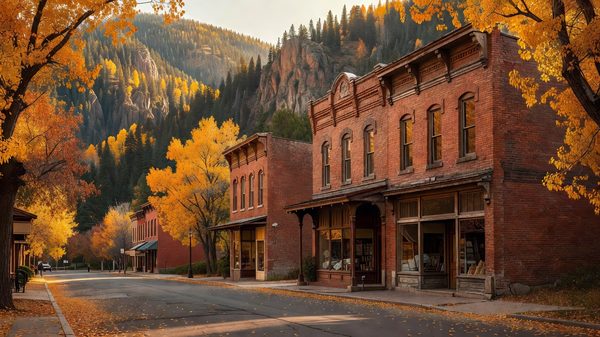
Most Colorado fall-color coverage sends you west — Kebler Pass, Independence Pass, the San Juans. Those are genuinely spectacular and they are also a long drive from Manitou Springs, which means a leaf-peeping trip turns into an overnight rather than a morning.
The Pikes Peak region has its own aspen, and enough of it that the drive west is a preference rather than a requirement. What it demands instead is attention to elevation and timing, because the color band moves down the mountain over several weeks and a trip planned to the wrong altitude arrives either early or late.
When Color Actually Peaks Here
In the Pikes Peak region, peak color generally runs from late September through early to mid-October, with the turn beginning anywhere from mid-September to early October depending on the year’s moisture and temperature pattern.
The mechanism that matters for planning is elevation. Aspens turn from the top down — high-elevation groves color first, and the band works its way lower over roughly two to three weeks. In practice that means a single “peak weekend” is the wrong mental model for this region. In late September you want to be high; by the second week of October you want to be lower.
That is useful rather than academic, because the sites below sit at meaningfully different elevations, and picking the right one for the week you are visiting matters more than picking the “best” one in the abstract.
Mueller State Park — The Most Reliable Option
Mueller State Park, near Divide on the west side of Pikes Peak, is the anchor of aspen viewing in this region. It combines extensive aspen and pine stands with grassy meadows, wildlife that is genuinely visible rather than theoretical, and a trail system that lets you choose your distance.
The trail most often named for aspen is the Cheesman Ranch Loop on the north end of the park — roughly five and a half miles, moderate, winding in and out of aspen groves and open meadows. Sources vary somewhat on the exact mileage depending on which connecting segments are included, so treat five to five and a half miles as the working figure. The loop is open to hikers, mountain bikers, and horses.
A Colorado Parks and Wildlife vehicle pass is required — a daily pass or a CPW annual pass. Check the current rate with CPW before you go rather than relying on a figure from an older trip report.
Mueller sits high enough that it colors relatively early in the window. Late September is generally the stronger bet here.
The Pikes Peak Highway’s Lower Miles
The lower portion of the Pikes Peak Highway climbs through dense forest and aspen stands before it breaks out above treeline, and it is a legitimate fall-color drive in its own right. Crystal Creek Reservoir, at roughly 6.5 miles into the drive, is a long-standing favorite for fall photographs — an alpine reservoir with color on the surrounding slopes.
Two practical caveats that catch people out, and they matter more in October than in September.
Crystal Creek sits inside the North Slope Recreation Area, which has its own $5 per-person fee (plus a $1 parking permit in 2026), its own hours, and a hard seasonal close on the third Sunday in October — October 18 in 2026. From October 1 until closing, its hours run 9 a.m. to 4 p.m. Our North Slope Recreation Area guide covers the full schedule and rules.
And the Pikes Peak Highway itself shifts to a 9 a.m. uphill opening on October 1, which removes the early-morning light that makes aspen photography work. See our guide to the highway after Labor Day for the full schedule and the vehicle restrictions, which are stricter than most visitors expect.
The upshot: this is a September drive if you can manage it. In October it is still good and it is on a much shorter clock.
Gold Camp Road — The Free One
Gold Camp Road is a free public road running southwest out of Colorado Springs along the bed of a former railroad grade, popular with cyclists and hikers, with repeated views over aspen and cottonwood stands. It is unpaved for much of its length.
Its virtue is that it costs nothing, requires no pass, and has no operating hours to plan around — which makes it the natural fallback when the fee areas are closed or when you want an unplanned afternoon rather than a scheduled outing. Its drawback is the surface: check current conditions and closures before committing, and think about whether your vehicle is happy on a rough dirt road before you are ten miles into one.
Victor and the Vindicator Valley Trail
Further out, the old mining district around Victor offers something the closer options do not: aspen groves set against a landscape of headframes, tailings, and gold-rush industrial remains. The Vindicator Valley Trail is the one usually singled out — a relatively short interpretive loop threading through aspen with the historic mining works in view.
This is the pick if you want the color to be part of a day out rather than the entire point of it. Victor and Cripple Creek are a proper excursion from Manitou Springs, and combining the trail with the mining district makes the drive worth it in a way that a single overlook would not.
Where to Base Yourself
Woodland Park, Cascade, and Green Mountain Falls all sit along the US-24 corridor between Manitou Springs and the higher country, and each puts you closer to Mueller and the highway than Colorado Springs does.
For campers and RV travelers, note the seasonal problem: most of the region’s campgrounds are closing or closed during peak color. Lone Duck in Cascade typically runs only through the last weekend in September, and Pike National Forest campgrounds scale back services outside the peak window. Our Manitou Springs camping guide covers which options actually stay open later.
Timing the Trip
If you can only pick one week, target the last week of September. It is the overlap where the high-elevation groves at Mueller and along the upper highway are at or near peak, the Pikes Peak Highway is still on its full summer schedule through September 30, the North Slope is still on 7:30 a.m. hours, and the summer crowds are gone.
If you are visiting in October, drop your elevation. Gold Camp Road, the Victor area, and the lower canyon stands hold color later than the high country, and none of them are governed by the October 1 schedule changes that compress a Pikes Peak Highway day.
Color timing shifts year to year with moisture and temperature, so check a current condition report in the week before you travel rather than booking around an average.
Frequently Asked Questions
When do aspens peak near Manitou Springs?
Generally late September through early to mid-October. High-elevation groves turn first and the color band moves downhill over roughly two to three weeks, so the best destination depends on which week you are visiting.
What’s the best aspen hike close to Manitou Springs?
The Cheesman Ranch Loop at Mueller State Park is the most commonly recommended — roughly five to five and a half miles, moderate, through aspen groves and meadows on the park’s north end. A CPW vehicle pass is required.
Can I still see fall color from the Pikes Peak Highway in October?
Yes, but on a shorter day. The uphill gates open at 9 a.m. starting October 1, and Crystal Creek Reservoir sits inside the North Slope Recreation Area, which runs 9 a.m.–4 p.m. in October and closes for the season on October 18 in 2026.
Is there a free option?
Gold Camp Road. It is a free public road with no pass requirement and no operating hours, though much of it is unpaved and conditions should be checked before you drive it.
Sources: Colorado Parks and Wildlife — Mueller State Park, City of Colorado Springs — North Slope Recreation Area, Pikes Peak Hours and Rates.